Forum |  HardWare.fr | News | Articles | PC | S'identifier | S'inscrire | Shop Recherche
8053 connectés 


Vidéoprojecteur ou TV ?


Attention si vous cliquez sur "voir les résultats" vous ne pourrez plus voter

 Mot :   Pseudo :  
  Aller à la page :
 
 Page :   1  2  3  4  5  ..  1772  1773  1774  ..  2394  2395  2396  2397  2398  2399
Auteur Sujet :

[Topic Unique] Home Cinema [ attention au lapin ]

n°2022622
thandor
Posté le 02-03-2016 à 09:23:02  profilanswer
 

Reprise du message précédent :
Quelle largeur d'écran de projection me conseillez-vous avec un recul de 3 mètres ?
Je lis sur les sites 2 mètres mais pas mal d'amateurs sur des forums prennent carrément 2,40m.
Cela me parait énorme...


Message édité par thandor le 02-03-2016 à 09:23:19
mood
Publicité
Posté le 02-03-2016 à 09:23:02  profilanswer
 

n°2022626
SuppotDeSa​Tante
Aka dje69r
Posté le 02-03-2016 à 09:33:47  profilanswer
 

Ca dépend de tes gouts... Perso j'aime que l'image prenne un max de mon champ de vision...


Ensuite faut voir avec le projo...
Topic idoine

Message cité 1 fois
Message édité par SuppotDeSaTante le 02-03-2016 à 09:35:42

---------------
Soyez malin, louez entre voisins !
n°2022628
tigui
Posté le 02-03-2016 à 09:46:14  profilanswer
 

J'ai un problème avec mon ampli Pioneer VSX-922. Je n'arrive pas à activer le caisson lorsque je lis des musiques.  
Je passe par un WD TV, quand je lis un bluray ou un MKV tout va bien le 5.1 s'active. Mais quand je lis une musique il passe en stéréo, j'ai beau changer les modes, rien n('y change. Quelqu'un aurait une idée? :)

n°2022629
thandor
Posté le 02-03-2016 à 09:51:19  profilanswer
 

SuppotDeSaTante a écrit :

Ca dépend de tes gouts... Perso j'aime que l'image prenne un max de mon champ de vision...
 
Ensuite faut voir avec le projo...  
Topic idoine


Visiblement aucun soucis avec le projo selon la simulation de chez son-video
http://img15.hostingpics.net/pics/847074BenQ.jpg

n°2022630
jonas
c'est mon identité
Posté le 02-03-2016 à 09:51:43  profilanswer
 

tigui a écrit :

J'ai un problème avec mon ampli Pioneer VSX-922. Je n'arrive pas à activer le caisson lorsque je lis des musiques.
Je passe par un WD TV, quand je lis un bluray ou un MKV tout va bien le 5.1 s'active. Mais quand je lis une musique il passe en stéréo, j'ai beau changer les modes, rien n('y change. Quelqu'un aurait une idée? :)


La musique, c'est stéréo.


Tu peux indiquer tes frontales comme small, et là ton caisson devrait prendre le relais en dessous du crossover choisi, par exemple 80 Hz pourrait être correct.


Sinon, en fonction des amplis, y'a parfois une option qui permet de forcer la sortie sub même en stéréo, genre "double bass" à activer.


C'est quoi, tes enceintes ?


Message édité par jonas le 02-03-2016 à 09:54:45

---------------
et voilà
n°2022632
jonas
c'est mon identité
Posté le 02-03-2016 à 09:53:50  profilanswer
 

thandor a écrit :


Visiblement aucun soucis avec le projo selon la simulation de chez son-video
http://img15.hostingpics.net/pics/847074BenQ.jpg


En tout cas n'oublie pas qu'il n'y a pas de lens shift sur le w1070.


---------------
et voilà
n°2022633
thandor
Posté le 02-03-2016 à 10:02:48  profilanswer
 

jonas a écrit :


En tout cas n'oublie pas qu'il n'y a pas de lens shift sur le w1070.


Y en a un, uniquement vertical.
A priori, en le fixant au plafond en position centrale, ca devrait donc pas poser problème !?

n°2022639
DTSman
Keep Of The Sound
Posté le 02-03-2016 à 10:23:29  profilanswer
 

loukoum a écrit :


Je reviens la dessus, j'ai toujours un doute, sur mon denon (1910), j'ai en fait   2 "réglages" Le Dyn Eq" on/off, et le "Dyn vol" on/0ff..
Lorsque je coupe le Dyn Eq, je n'ai plus de petit voyant, et je suppose que le reglage fait pas la calibration n'est plus pris en compte..
La ou j'ai un doute, c'est justement avec le Dyn Vol, pour lequel j'ai un voyant rouge lorsqu'il est sur off, et vert qd il est sur on..
Comme il me semblait que ce Dyn Vol était utilisé pour diminuer la plage de volume entre les sons forts (explosions) et les faibles (voix), je m'en suis servi hier soir, j'avais des petits qui dormaient au 1er..
Je me suis maté Edge of tomorrow (en BR), et dés que ca pétait un peu, je me rendais clairement compte que le volume de la centrale/les avants était baissé..
Il sert a quoi ce réglage en fait, il faut le mettre sur on ou off?
 
edit: j'aurais du lire les 2 dernieres pages avant de vouloir quoter ^^ donc, la bonne methode lorsqu'on vit pas en caverne, c'est le Dyn vol sur on, petite led verte, et si on trouve que c trop juste sur la centrale, on remonte a la main?


Le "dynamic volume" est à proscrire tant que possible. Il écrase la dynamique de la piste son (il est à comparer avec le mode Midnight des pistes AC3).


---------------
Tuto ColorHCFR : Home-cinema & Multimedia
n°2022640
Faluja
Désanusseur de moules
Posté le 02-03-2016 à 10:26:18  profilanswer
 

[:the mac:2]


---------------
On peut pas s'arrêter ici ! C'est le pays des chauves souris !
n°2022643
DTSman
Keep Of The Sound
Posté le 02-03-2016 à 10:31:59  profilanswer


tu peux expliciter?


---------------
Tuto ColorHCFR : Home-cinema & Multimedia
mood
Publicité
Posté le 02-03-2016 à 10:31:59  profilanswer
 

n°2022644
Faluja
Désanusseur de moules
Posté le 02-03-2016 à 10:37:17  profilanswer
 

DTSman a écrit :


tu peux expliciter?


Citation :

If you’ve shopped for a new A/V receiver anytime in the past few years, you’ve no doubt seen Audyssey’s logo join the ever-growing collection of silk-screened faceplate emblems. The company’s MultEQ automatic room correction system has quickly become the de facto standard for equalization in home theater, and is included these days as standard equipment on receivers and preamps from Denon, Integra, Onkyo, NAD, and Marantz (View slideshow of Audyssey-enabled receivers). Recently, Audyssey introduced two new sound-shaping technologies to the market, dubbed Dynamic EQ and Dynamic Volume, which take the concept of automatic room correction to the next level. To get the skinny on these new features, we sat down with Chris Kyriakakis, founder and chief technology officer of Audyssey, to discuss their origins and the problems they hope to address.
 
Let’s talk about Audyssey’s Dynamic EQ feature, which we’ve seen popping up on A/V receivers as of late. How does it work?  
Well, Dynamic EQ is an extension of our room correction technology, MultEQ, so let’s talk about that for a minute first. MultEQ was designed after lots of research at the University of Southern California, where I teach along with Tom Holman, one of our co-founders. It’s unique because it was the first [room correction solution] to address how you take sound measurements in a room at multiple positions, and how you combine those measurements to make filters that fix audio problems over a large listening area.
 
The most common way of doing room EQ is that you put a microphone at your main listening position, play some pink noise, and then you look at the frequency response and make an inverse of that…
 
In other words, if you find a two-decibel spike at a certain frequency, you counter that with a two-decibel cut at that frequency, and vice versa, in an attempt to flatten out the EQ curve in the room—to make sure that no particular frequency is accentuated over any other…
 
Right. But there are several problems with that that way it’s been done before. First off, measuring pink noise means you’re only measuring the frequency response—you’re time blind. In other words, you don’t know what part of the signal was direct sound from the speakers and what part of the signal was reflected off of other surfaces.
 
So to address that problem we came up with a method of measuring impulse responses—bursts of sound—which gives you a lot more information about what’s happening in the room in the time domain. We’re not just adjusting frequencies; we’re adjusting delays, as well. And we come up with the right frequency adjustments and delay settings by taking six or eight measurements and looking at them as patterns: maybe positions one and four give us very similar measurements, for example; that means they have very similar acoustical problems. Positions two, five, and six may also be very similar to each other, but different from one and four. And perhaps the third measuring position is so different that is has a unique response. Based on all of that information, we apply a weighting to the problems. If enough seats have the same problem, then it’s more important than the one seat that has unique issues. And you keep doing that over the entire frequency range, and you come up with this weighted combination, which is better than what others have tried in the past, which was simply taking six measurements and averaging them.
 
So how does Dynamic EQ fit into the picture?
Well, we’ve found that when you do all of that and equalize a room to a particular target equalization curve, what you’re really doing is equalizing it at what’s called “reference level,” which is the level the person mixing the content was listening to on the mixing stage. But the level at which mixers listen in Hollywood is much higher than “civilian levels,” as we call them. Our installers tell us that the average home user listens at -10 to -20 on the volume knob, and the minute you turn the sound down that far, your perception changes—the balance between bass and mid and treble is completely changed.
 
This isn’t a new thought, of course: what’s known as “loudness control” came about to address this, and it’s been around for many years. But the reason loudness controls disappeared is that they really weren’t effective.
 
If you have a passage of music that has loud and soft parts when you’re at high volumes, and then you lower the volume, the soft parts need more correction than the louder parts. So we had to invent a way of measuring perceived loudness in every channel, running in real time. And that’s what Dynamic EQ does. Every channel has its own loudness meter that looks at the content as its coming through and estimates—based on the signal and our human models—how a human will perceive it. So it makes minute adjustments, and of course it doesn’t just rapidly go up and down or you would notice it. We smooth it out. That’s part of the innovation here—that’s why we called it Dynamic.
 
So how did you develop the human model for this?
We work a lot with professional mixers at the university because of Tom [Holman]’s connections. So we did a number of experiments with them. In one of them we put them in front of the console and turned down the master fader, and the first reaction they had to their own mixes was, “what happened to my surrounds?” It turns out that loudness perception is spatial—it falls off faster behind us than it does in front of us. And we asked these mixers, “OK, you’re down 10dB, what would you do to the surrounds to maintain the surround impression?” And they would move it up, and at different levels they would move it up by different amounts. So if you do that with enough people you can come up with a set of rules that mimic what they’re doing.
 
So we integrated that into Dynamic EQ—as you turn the volume down, the surround levels go up a little or a lot, depending on how far down you are, to maintain the impression of surround. And the best way to demo that is to turn the volume down 20dB and turn off Dynamic EQ, and all of the sound collapses to the front.
 
How does Dynamic Volume fit into all of this?
So, continuing with our story of the mixers—we had probably 20 people who participated in this set of experiments, initiated by Tom Holman, who was puzzled for a long time by one particular problem: why is it that a mix that is done in the dubbing stage doesn’t work as well in our home theaters? Why do we need to keep adjusting the volume—up to hear the dialogue and down when the action gets heavy? Why do we need to do it at home, but not in the movie theater? We have high end equipment. What’s going on?
 
What we found was that the content is mixed for movie theater systems with extremely high dynamic range—very powerful amps, big speakers, in huge rooms. But when you bring that into the home the sound pressure levels that you perceive change, the perceived dynamic range changes, and it’s affected by the size of the room and the ability of your system. So the first thought was, We have to control the dynamic range, but we can’t do it by putting a compressor in the signal path, because that doesn’t work—it introduces artifacts.
 
By “compressor,” you mean things like Night-time Mode or Midnight Mode, and similar dynamic range controls on many A/V receivers, which make loud sounds quieter and quiet sounds louder…
Exactly. So to find a better solution, we brought mixers in to work with content that they knew and said, “Pretend your daughter is sleeping next door, and make adjustments to this mix in real time.” And we set up a system to electronically track their movements and in parallel record the content in 5.1. When we were done we had a seven- or eight-terabyte database that we gave to our research team and said, “We need to reverse engineer their decisions. Why did they turn the sound down when they did, and when they did turn it down how fast were they reacting? What were they reacting to? What was the content in every channel?” And we came up with an algorithm that mimicked those decisions. And so Dynamic Volume came out of these experiments. It uses a look-ahead method, with a small buffer, and looks at what’s about to play in each channel…
 
How far does it look ahead?
That’s adjustable. It depends on who we’re working with. A TV manufacturer will give us a lot because they’re already doing video processing and they don’t care. An A/V receiver manufacturer will not give us as much look-ahead time—it’s about half a frame. The more the better, obviously, but you don’t want to be introducing delay more than you have for video, so we’re limited by that.  
 
So, aside from the look-ahead buffer, what makes Dynamic Volume different from other dynamic range controls?
Well, the average person adjusts the volume level so dialogue sounds right. That’s what’s important to them. They just don’t want to have to run from the room when the explosions come, or at commercial breaks. So we keep dialogue as reference, and then monitor the signal above or below and decide how much to bring it up or down. The trick was to do that without using a compressor, as I mentioned before, because a compressor has a fixed time constant. If things are too soft it boosts, and if things are too loud it cuts. But it doesn’t have any knowledge of how quickly they’re becoming soft or loud. And so by the time it catches most things they’re already changing in the other direction.
 
 
Some improvements have been made to compressors over the years, where you take the signal and break it up into different frequency bands, and put a compressor on each of those bands, the idea being that only the frequency bands that have something loud in them will be compressed, and not the whole signal. But if there’s an explosion, which means the 60-70Hz bands have something extremely loud in them and the rest don’t, if you compress those bands and bring them down, you’ve done changed the frequency response, because you’re turning down just the bass. And Hollywood mixers get very upset when you do that. They’re okay with you turning the volume down. That’s one thing. But intentionally changing the frequency response is not okay with them. So we don’t use bands.
 
Our approach is different. We look at the time domain signal as it’s varying, estimate how loud it is, and make adjustments slowly or rapidly, depending upon what needs to happen.
 
What do you say to people who accuse you of tinkering with the artistic intent of a carefully crafted surround sound mix?
Actually, I say that we’re trying to preserve it. Whether it’s the user or the system turning the volume down, Dynamic EQ is tied into Dynamic Volume. So, if I make it softer, all of the things I said earlier about preserving the frequency response and the spatial impression are still in play, whether it’s done automatically or not. You can’t turn on Dynamic Volume without having Dynamic EQ on. So for that reason, we’re actually preserving the artistic intent of the surround sound mix, considering the fact that the user simply isn’t going to play it at the volumes it was mixed for. So, given the reality of real-world listening situations, we’re trying to translate the artistic intent as much as possible.
 
You say you can’t turn on Dynamic Volume without turning on Dynamic EQ—is the inverse true, as well?
No, you can turn on Dynamic EQ without engaging Dynamic Volume. If you have a dedicated room and you want to listen at reference levels, or for whatever reason you don’t want or need Dynamic Volume on, you can turn it off and Dynamic EQ will stay on.
 
It seems like a lot of what you’re doing is taking mixes that were intended for large cinematic spaces and modifying them so they work better at home. What about the DVDs and Blu-rays on the market that contain near field mixes, specifically designed for home theater?
 
Dynamic EQ and Dynamic Volume really aren’t affected by that, but what is affected is the target equalization curve choice in MultEQ. The high-frequency roll-off that is in the Denons and other receivers is called the Audyssey Curve. That assumes that the mix was done for theaters [and therefore mixed with increased high-frequencies to compensate for the sound passing through a large cinema screen]. So if you have a mix that was actually done for the home, we recommend that you switch to the Audyssey Flat Curve. The problem is, you don’t always know. I wish the studios would make it clearer, who does it and who does not. It’s not the majority of them, but there are some—New Line and a few others—who do this. So we have no way of making it automatic, because we have no way of knowing whether the mix was done for theaters or for home. But if you do know you’ve got a near field mix, you should set it to Flat.
 
Could it be made automatic somehow? Could the sound mixers put a flag in the bitstream?
Yeah, Tom is trying to get them to do that. He knows a lot of the post-production houses, and there are empty flags in Dolby Digital that could be used for things like that, but habits are hard to break. Those guys just don’t use flags. I think that it will happen eventually. I’m just not sure how soon it will happen.
 
What’s the next big problem you want to solve?
The next big problem relates to MultEQ: in our pro applications, our installer applications, we provide a few more options than what you have as a consumer. We’ve come up with a few preset equalization curves that work for different sized rooms, because different sized rooms require different amounts of high-frequency roll-off, depending on how much acoustical treatment they have. So today we do that with presets and guidelines. But what we’re working on is to make that completely automatic, so that a measurement of the reverberation time and knowledge about the size of the room and the position of the primary listening position—because that affects how much direct sound and how much reverberant sound you’re getting—will give us exactly the right EQ curve for that room. That’s a lofty goal. It’s a really difficult problem. But we have a good team that’s working on it now, and we have a whole series of experiments that we’re doing in the lab to figure this out.
 
When might we start to see that?
My best guess is that we might start to see models with that appearing… a year from now. That’s just a guess, though.


---------------
On peut pas s'arrêter ici ! C'est le pays des chauves souris !
n°2022661
moiata
Posté le 02-03-2016 à 11:47:50  profilanswer
 

Faluja a écrit :

 
Citation :

bababla,bababla,....................................................................bababla,bababla. bla bla


Ça confirme bien que toi et galork faite l'amalgame* entre le Audyssey’s Dynamic EQ et le Dynamic Volume...  
C'est l'Audyssey’s Dynamic EQ votre "loudness magique" et le Dynamic Volume c'est le castrateur de son pour les pub quand vous regardez une série tv sur TF1 :lol:


*Définition d'amalgame: Faire l'amalgame entre des choses ou des gens, les mêler intentionnellement pour créer la confusion

Message cité 1 fois
Message édité par moiata le 02-03-2016 à 12:26:22
n°2022664
DTSman
Keep Of The Sound
Posté le 02-03-2016 à 11:51:33  profilanswer
 

Faluja a écrit :


Citation :

If you’ve shopped for a new A/V receiver anytime in the past few years, you’ve no doubt seen Audyssey’s logo join the ever-growing collection of silk-screened faceplate emblems. The company’s MultEQ automatic room correction system has quickly become the de facto standard for equalization in home theater, and is included these days as standard equipment on receivers and preamps from Denon, Integra, Onkyo, NAD, and Marantz (View slideshow of Audyssey-enabled receivers). Recently, Audyssey introduced two new sound-shaping technologies to the market, dubbed Dynamic EQ and Dynamic Volume, which take the concept of automatic room correction to the next level. To get the skinny on these new features, we sat down with Chris Kyriakakis, founder and chief technology officer of Audyssey, to discuss their origins and the problems they hope to address.
 
Let’s talk about Audyssey’s Dynamic EQ feature, which we’ve seen popping up on A/V receivers as of late. How does it work?  
Well, Dynamic EQ is an extension of our room correction technology, MultEQ, so let’s talk about that for a minute first. MultEQ was designed after lots of research at the University of Southern California, where I teach along with Tom Holman, one of our co-founders. It’s unique because it was the first [room correction solution] to address how you take sound measurements in a room at multiple positions, and how you combine those measurements to make filters that fix audio problems over a large listening area.
 
The most common way of doing room EQ is that you put a microphone at your main listening position, play some pink noise, and then you look at the frequency response and make an inverse of that…
 
In other words, if you find a two-decibel spike at a certain frequency, you counter that with a two-decibel cut at that frequency, and vice versa, in an attempt to flatten out the EQ curve in the room—to make sure that no particular frequency is accentuated over any other…
 
Right. But there are several problems with that that way it’s been done before. First off, measuring pink noise means you’re only measuring the frequency response—you’re time blind. In other words, you don’t know what part of the signal was direct sound from the speakers and what part of the signal was reflected off of other surfaces.
 
So to address that problem we came up with a method of measuring impulse responses—bursts of sound—which gives you a lot more information about what’s happening in the room in the time domain. We’re not just adjusting frequencies; we’re adjusting delays, as well. And we come up with the right frequency adjustments and delay settings by taking six or eight measurements and looking at them as patterns: maybe positions one and four give us very similar measurements, for example; that means they have very similar acoustical problems. Positions two, five, and six may also be very similar to each other, but different from one and four. And perhaps the third measuring position is so different that is has a unique response. Based on all of that information, we apply a weighting to the problems. If enough seats have the same problem, then it’s more important than the one seat that has unique issues. And you keep doing that over the entire frequency range, and you come up with this weighted combination, which is better than what others have tried in the past, which was simply taking six measurements and averaging them.
 
So how does Dynamic EQ fit into the picture?
Well, we’ve found that when you do all of that and equalize a room to a particular target equalization curve, what you’re really doing is equalizing it at what’s called “reference level,” which is the level the person mixing the content was listening to on the mixing stage. But the level at which mixers listen in Hollywood is much higher than “civilian levels,” as we call them. Our installers tell us that the average home user listens at -10 to -20 on the volume knob, and the minute you turn the sound down that far, your perception changes—the balance between bass and mid and treble is completely changed.
 
This isn’t a new thought, of course: what’s known as “loudness control” came about to address this, and it’s been around for many years. But the reason loudness controls disappeared is that they really weren’t effective.
 
If you have a passage of music that has loud and soft parts when you’re at high volumes, and then you lower the volume, the soft parts need more correction than the louder parts. So we had to invent a way of measuring perceived loudness in every channel, running in real time. And that’s what Dynamic EQ does. Every channel has its own loudness meter that looks at the content as its coming through and estimates—based on the signal and our human models—how a human will perceive it. So it makes minute adjustments, and of course it doesn’t just rapidly go up and down or you would notice it. We smooth it out. That’s part of the innovation here—that’s why we called it Dynamic.
 
So how did you develop the human model for this?
We work a lot with professional mixers at the university because of Tom [Holman]’s connections. So we did a number of experiments with them. In one of them we put them in front of the console and turned down the master fader, and the first reaction they had to their own mixes was, “what happened to my surrounds?” It turns out that loudness perception is spatial—it falls off faster behind us than it does in front of us. And we asked these mixers, “OK, you’re down 10dB, what would you do to the surrounds to maintain the surround impression?” And they would move it up, and at different levels they would move it up by different amounts. So if you do that with enough people you can come up with a set of rules that mimic what they’re doing.
 
So we integrated that into Dynamic EQ—as you turn the volume down, the surround levels go up a little or a lot, depending on how far down you are, to maintain the impression of surround. And the best way to demo that is to turn the volume down 20dB and turn off Dynamic EQ, and all of the sound collapses to the front.
 
How does Dynamic Volume fit into all of this?
So, continuing with our story of the mixers—we had probably 20 people who participated in this set of experiments, initiated by Tom Holman, who was puzzled for a long time by one particular problem: why is it that a mix that is done in the dubbing stage doesn’t work as well in our home theaters? Why do we need to keep adjusting the volume—up to hear the dialogue and down when the action gets heavy? Why do we need to do it at home, but not in the movie theater? We have high end equipment. What’s going on?
 
What we found was that the content is mixed for movie theater systems with extremely high dynamic range—very powerful amps, big speakers, in huge rooms. But when you bring that into the home the sound pressure levels that you perceive change, the perceived dynamic range changes, and it’s affected by the size of the room and the ability of your system. So the first thought was, We have to control the dynamic range, but we can’t do it by putting a compressor in the signal path, because that doesn’t work—it introduces artifacts.
 
By “compressor,” you mean things like Night-time Mode or Midnight Mode, and similar dynamic range controls on many A/V receivers, which make loud sounds quieter and quiet sounds louder…
Exactly. So to find a better solution, we brought mixers in to work with content that they knew and said, “Pretend your daughter is sleeping next door, and make adjustments to this mix in real time.” And we set up a system to electronically track their movements and in parallel record the content in 5.1. When we were done we had a seven- or eight-terabyte database that we gave to our research team and said, “We need to reverse engineer their decisions. Why did they turn the sound down when they did, and when they did turn it down how fast were they reacting? What were they reacting to? What was the content in every channel?” And we came up with an algorithm that mimicked those decisions. And so Dynamic Volume came out of these experiments. It uses a look-ahead method, with a small buffer, and looks at what’s about to play in each channel…
 
How far does it look ahead?
That’s adjustable. It depends on who we’re working with. A TV manufacturer will give us a lot because they’re already doing video processing and they don’t care. An A/V receiver manufacturer will not give us as much look-ahead time—it’s about half a frame. The more the better, obviously, but you don’t want to be introducing delay more than you have for video, so we’re limited by that.  
 
So, aside from the look-ahead buffer, what makes Dynamic Volume different from other dynamic range controls?
Well, the average person adjusts the volume level so dialogue sounds right. That’s what’s important to them. They just don’t want to have to run from the room when the explosions come, or at commercial breaks. So we keep dialogue as reference, and then monitor the signal above or below and decide how much to bring it up or down. The trick was to do that without using a compressor, as I mentioned before, because a compressor has a fixed time constant. If things are too soft it boosts, and if things are too loud it cuts. But it doesn’t have any knowledge of how quickly they’re becoming soft or loud. And so by the time it catches most things they’re already changing in the other direction.
 
 
Some improvements have been made to compressors over the years, where you take the signal and break it up into different frequency bands, and put a compressor on each of those bands, the idea being that only the frequency bands that have something loud in them will be compressed, and not the whole signal. But if there’s an explosion, which means the 60-70Hz bands have something extremely loud in them and the rest don’t, if you compress those bands and bring them down, you’ve done changed the frequency response, because you’re turning down just the bass. And Hollywood mixers get very upset when you do that. They’re okay with you turning the volume down. That’s one thing. But intentionally changing the frequency response is not okay with them. So we don’t use bands.
 
Our approach is different. We look at the time domain signal as it’s varying, estimate how loud it is, and make adjustments slowly or rapidly, depending upon what needs to happen.
 
What do you say to people who accuse you of tinkering with the artistic intent of a carefully crafted surround sound mix?
Actually, I say that we’re trying to preserve it. Whether it’s the user or the system turning the volume down, Dynamic EQ is tied into Dynamic Volume. So, if I make it softer, all of the things I said earlier about preserving the frequency response and the spatial impression are still in play, whether it’s done automatically or not. You can’t turn on Dynamic Volume without having Dynamic EQ on. So for that reason, we’re actually preserving the artistic intent of the surround sound mix, considering the fact that the user simply isn’t going to play it at the volumes it was mixed for. So, given the reality of real-world listening situations, we’re trying to translate the artistic intent as much as possible.
 
You say you can’t turn on Dynamic Volume without turning on Dynamic EQ—is the inverse true, as well?
No, you can turn on Dynamic EQ without engaging Dynamic Volume. If you have a dedicated room and you want to listen at reference levels, or for whatever reason you don’t want or need Dynamic Volume on, you can turn it off and Dynamic EQ will stay on.
 
It seems like a lot of what you’re doing is taking mixes that were intended for large cinematic spaces and modifying them so they work better at home. What about the DVDs and Blu-rays on the market that contain near field mixes, specifically designed for home theater?
 
Dynamic EQ and Dynamic Volume really aren’t affected by that, but what is affected is the target equalization curve choice in MultEQ. The high-frequency roll-off that is in the Denons and other receivers is called the Audyssey Curve. That assumes that the mix was done for theaters [and therefore mixed with increased high-frequencies to compensate for the sound passing through a large cinema screen]. So if you have a mix that was actually done for the home, we recommend that you switch to the Audyssey Flat Curve. The problem is, you don’t always know. I wish the studios would make it clearer, who does it and who does not. It’s not the majority of them, but there are some—New Line and a few others—who do this. So we have no way of making it automatic, because we have no way of knowing whether the mix was done for theaters or for home. But if you do know you’ve got a near field mix, you should set it to Flat.
 
Could it be made automatic somehow? Could the sound mixers put a flag in the bitstream?
Yeah, Tom is trying to get them to do that. He knows a lot of the post-production houses, and there are empty flags in Dolby Digital that could be used for things like that, but habits are hard to break. Those guys just don’t use flags. I think that it will happen eventually. I’m just not sure how soon it will happen.
 
What’s the next big problem you want to solve?
The next big problem relates to MultEQ: in our pro applications, our installer applications, we provide a few more options than what you have as a consumer. We’ve come up with a few preset equalization curves that work for different sized rooms, because different sized rooms require different amounts of high-frequency roll-off, depending on how much acoustical treatment they have. So today we do that with presets and guidelines. But what we’re working on is to make that completely automatic, so that a measurement of the reverberation time and knowledge about the size of the room and the position of the primary listening position—because that affects how much direct sound and how much reverberant sound you’re getting—will give us exactly the right EQ curve for that room. That’s a lofty goal. It’s a really difficult problem. But we have a good team that’s working on it now, and we have a whole series of experiments that we’re doing in the lab to figure this out.
 
When might we start to see that?
My best guess is that we might start to see models with that appearing… a year from now. That’s just a guess, though.


So what? Tu préconises donc d'utiliser le Dyn. Vol.?
 
Entre la théorie et la pratique il y a un monde. J'ai testé et je ne valide pas. C'est comme brider son installation HC. Autant arreter le HC et repasser à une simple chaine stereo tant qu'à faire.
 
EDIT: Je précise que je parle bien du Dyn. Vol. et non du Dyn. Eq.

Message cité 2 fois
Message édité par DTSman le 02-03-2016 à 11:55:01

---------------
Tuto ColorHCFR : Home-cinema & Multimedia
n°2022670
Faluja
Désanusseur de moules
Posté le 02-03-2016 à 12:25:22  profilanswer
 

moiata a écrit :


Ça confirme bien que toi et galork faite l'amalgame* entre le Audyssey’s Dynamic EQ et le Dynamic Volume...  
C'est l'Audyssey’s Dynamic EQ votre "loudness magique" et le Dynamic Volume c'est le castrateur de son pour les pub quand vous regardez une série tv sur TF1 :lol:


*Définition d'amalgame: Faire l'amalgame entre des choses ou des gens, les mêler intentionnellement pour créer la confusion


Ouais t'as pas lu quoi, aides toi de google trad si t'as du mal avec l'anglais.
 

DTSman a écrit :


So what? Tu préconises donc d'utiliser le Dyn. Vol.?
 
Entre la théorie et la pratique il y a un monde. J'ai testé et je ne valide pas. C'est comme brider son installation HC. Autant arreter le HC et repasser à une simple chaine stereo tant qu'à faire.
 
EDIT: Je précise que je parle bien du Dyn. Vol. et non du Dyn. Eq.


Ca doit être parce que t'es déjà sourd à force de regarder tes films au volume de référence.


---------------
On peut pas s'arrêter ici ! C'est le pays des chauves souris !
n°2022672
moiata
Posté le 02-03-2016 à 12:36:38  profilanswer
 

Faluja a écrit :


Ouais t'as pas lu quoi, aides toi de google trad si t'as du mal avec l'anglais.


Faluja a écrit :


Ca doit être parce que t'es déjà sourd à force de regarder tes films au volume de référence.


Explique moi ce que je n'ai pas compris au sujet du Dynamic volume

 
DTSman a écrit :


So what? Tu préconises donc d'utiliser le Dyn. Vol.?


Entre la théorie et la pratique il y a un monde. J'ai testé et je ne valide pas. C'est comme brider son installation HC. Autant arreter le HC et repasser à une simple chaine stereo tant qu'à faire.


EDIT: Je précise que je parle bien du Dyn. Vol. et non du Dyn. Eq.


Tu va prendre cher ici avec de tels propos, j'espère que tu n'a pas de lecteur blu ray un peu "hdg" ...  :lol: (ce référer au deux trois dernières pages)


Mais bon certain ici trouve utile d’acheter des caissons de basses, des amplis de puissance pour alimenter des colonnes et brider tous ça avec le Dynamic volume et tout est normal...


enfin moi je passe à autre chose ... je vais mater un film tiens !

Message cité 1 fois
Message édité par moiata le 02-03-2016 à 12:41:43
n°2022676
DTSman
Keep Of The Sound
Posté le 02-03-2016 à 12:48:01  profilanswer
 

Faluja a écrit :


Ca doit être parce que t'es déjà sourd à force de regarder tes films au volume de référence.


Quelle argumentation  :jap:  
 
Je ne peux que t'inciter à faire un max de test on/off de cette option Audyssey pour te rendre compte de l'impact sur le rendu.
 

moiata a écrit :


Tu va prendre cher ici avec de tels propos, j'espère que tu n'a pas de lecteur blu ray un peu "hdg" ...  :lol:  


Une PS3 slim. ça c'est du high end  :)  
 

moiata a écrit :


Mais bon certain ici trouve utile d’acheter des caissons de basses, des amplis de puissance pour alimenter des colonnes et brider tous ça avec le Dynamic volume et tout est normal...
 
enfin moi je passe à autre chose ... je vais mater un film tiens !


Tu as bien raison. Enjoy your HC!  :jap:


---------------
Tuto ColorHCFR : Home-cinema & Multimedia
n°2022678
Faluja
Désanusseur de moules
Posté le 02-03-2016 à 12:53:28  profilanswer
 

DTSman a écrit :


Quelle argumentation  :jap:  
 
Je ne peux que t'inciter à faire un max de test on/off de cette option Audyssey pour te rendre compte de l'impact sur le rendu.


Aussi bonne que la tienne, sinon l'argumentation elle est dans le texte en anglais, on l'a déjà dit mille fois, la dynamique de la piste, au volume de référence, devient trop élevé si on baisse le volume, ce qui empêche d'entendre correctement les voix lors des pics de volume sur les front / surround, en bref c'est ce qui est expliqué, que ton salon n'est pas une salle de cinéma et que les pistes sur les bluray, issus des masters cinémas, ne sont pas adaptés pour une écoute en dessous du volume de référence d'où dynamic volume, qui ne compresse pas bêtement la piste mais l'analyse en permanence pour ajuster en temps réel lorsque cela est nécessaire, en prenant en compte les différentes fréquences.
 
Ca fait juste dix fois qu'on le répète, enfin chier sur dynamic volume, c'est du même niveau que chier sur la correction de la pièce effectuer par audyssey, ca n'a pas de sens.
 
Après si vous regardez vos films au volume de référence, tant mieux pour vous, perso je tiens un peu à mon audition.


Message édité par Faluja le 02-03-2016 à 12:59:39

---------------
On peut pas s'arrêter ici ! C'est le pays des chauves souris !
n°2022692
the_blob
Posté le 02-03-2016 à 14:27:37  profilanswer
 

https://www.youtube.com/watch?v=kV64Mj7qJew
 
 
On parle bien de ce genre de procédé ? Et pas d'une bête compression ?

n°2022696
DTSman
Keep Of The Sound
Posté le 02-03-2016 à 14:37:26  profilanswer
 

the_blob a écrit :

https://www.youtube.com/watch?v=kV64Mj7qJew
On parle bien de ce genre de procédé ? Et pas d'une bête compression ?


Oui cela semble être un system de castration de la dynamique équivalent.  :jap:  
 
Sur la brochure de l'audyssey Dynamique Volume on lit se type de description:
 

Citation :


- Fonction Audyssey Dynamic Volume, assurant l'ajustement du volume sonore en temps réel:
Des différences importantes de volume sonore se manifestent parfois entre les documentaires, où le son est principalement au service de la narration, et les films, qui font souvent intervenir des effets sonores de niveau très élevé. Les téléspectateurs montent souvent le volume sur les documentaires, afin de mieux entendre la narration, mais le baissent par la suite au moment des publicités, dont le son est souvent très fort. Cette situation se reproduit souvent au cours d'une soirée. La fonction Audyssey Dynamic Volume surveille en permanence les sources sonores, et ajuste leur volume à un niveau optimal pour chacune, sans sacrifier la gamme dynamique.


J'aime bien le "sans sacrifier la gamme dynamique" et la comparaison avec le passage publicitaire.
 
Rien ne vaut la pratique. Testez avec et sans. L'oreille est seule juge. Pour ma part je trouve absurde de brider la dynamique d'une piste audio HC. C'est justement les écarts entre les sons fort et faible qui donne de la véracité au rendu audio. A part éviter de réveiller bébé dans la pièce d'à coté je n'en vois pas l’intérêt.


---------------
Tuto ColorHCFR : Home-cinema & Multimedia
n°2022697
Faluja
Désanusseur de moules
Posté le 02-03-2016 à 14:40:25  profilanswer
 

Oui, d'ailleurs ils se sont inspirés de dynamic volume, je pense, cette fonction existe depuis longtemps, elle a été améliorée au fur et à mesure.
 
C'est pas une compression linéaire du tout, comme je l'ai dis cela analyse et corrige en temps réel.


---------------
On peut pas s'arrêter ici ! C'est le pays des chauves souris !
n°2022701
the_blob
Posté le 02-03-2016 à 14:53:47  profilanswer
 

DTSman a écrit :


Oui cela semble être un system de castration de la dynamique équivalent.  :jap:  
 
Sur la brochure de l'audyssey Dynamique Volume on lit se type de description:
 

Citation :


- Fonction Audyssey Dynamic Volume, assurant l'ajustement du volume sonore en temps réel:
Des différences importantes de volume sonore se manifestent parfois entre les documentaires, où le son est principalement au service de la narration, et les films, qui font souvent intervenir des effets sonores de niveau très élevé. Les téléspectateurs montent souvent le volume sur les documentaires, afin de mieux entendre la narration, mais le baissent par la suite au moment des publicités, dont le son est souvent très fort. Cette situation se reproduit souvent au cours d'une soirée. La fonction Audyssey Dynamic Volume surveille en permanence les sources sonores, et ajuste leur volume à un niveau optimal pour chacune, sans sacrifier la gamme dynamique.


J'aime bien le "sans sacrifier la gamme dynamique" et la comparaison avec le passage publicitaire.
 
Rien ne vaut la pratique. Testez avec et sans. L'oreille est seule juge. Pour ma part je trouve absurde de brider la dynamique d'une piste audio HC. C'est justement les écarts entre les sons fort et faible qui donne de la véracité au rendu audio. A part éviter de réveiller bébé dans la pièce d'à coté je n'en vois pas l’intérêt.


Dans mon cas , quand femme et enfants dorment , c'est sans appel , l'écoute sans est impossible j'entend pas les voix.  
 
C'est un artifice ok mais ça me permet de regarder le hc le soir .
 
Et c'est bien au dessus du drc de mon ex Yamaha je trouve.

n°2022707
Dakans
pouet pouet
Posté le 02-03-2016 à 15:31:34  profilanswer
 

Donc en gros ce truc c'est comme un Auto Rec Level, sa servait a limiter le niveaux max a l'enregistrement


---------------
Mieux vaut se taire et passer pour un con que de l'ouvrir et ne laisser aucun doute sur le sujet. (Coluche)
n°2022715
Elias de K​elliwich
Dit : Le Fourbe.
Posté le 02-03-2016 à 15:45:36  profilanswer
 

Dakans a écrit :

Donc en gros ce truc c'est comme un Auto Rec Level, sa servait a limiter le niveaux max a l'enregistrement


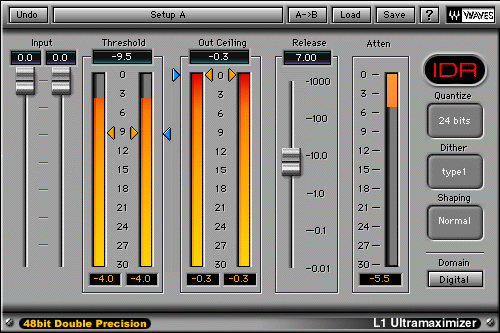
Non, c'est plutôt comme un compresseur / maximizer / gate (mais sans réglage et qui s'ajuste tout seul), alors que "l'Auto Rec Level", c'est plutôt comme un "normalizer".  ;)
 
http://static.kvraudio.com/i/b/l1ultramaximiser.jpg


Message édité par Elias de Kelliwich le 02-03-2016 à 15:48:19
n°2022719
racsoft1
Après moi le néant
Posté le 02-03-2016 à 15:56:35  profilanswer
 

Mode  :o   ON
 
 
Faluja : J'ai acheté une Ferrari mais je l'utilise presque tout le temps en mettant le limitateur de vitesse !
 
moiata : Ben pourquoi tu utilises ce truc si t'as une Ferrari ?
 
Faluja : Pour pas me prendre des prunes tiens, pour excès de vitesse!!
 
moiata : Ben dans ce cas achète juste une Clio si tu veux pas rouler vite  [:spamafote]  
 
Faluja : Oui mais de temps en temps je veux aller sur circuit pour pouvoir profiter de ma Ferrari.
 
moiata : Moi je roule à fond tout le temps et je m'en tape des gendarmes !!!
 
 
Mode  :o   OFF


---------------
Il ne faut jamais remettre à demain ce que l'on peut faire dans deux jours !
n°2022722
Faluja
Désanusseur de moules
Posté le 02-03-2016 à 16:02:30  profilanswer
 

Cette analogie toute moisie   :lol:  
 
En plus le dynamic volume est activé en permanence chez moi, ca a pas empêché de faire vibrer les murs lors de la scène du pont du dernier terminator.

Message cité 1 fois
Message édité par Faluja le 02-03-2016 à 16:02:44

---------------
On peut pas s'arrêter ici ! C'est le pays des chauves souris !
n°2022731
racsoft1
Après moi le néant
Posté le 02-03-2016 à 16:21:13  profilanswer
 

Faluja a écrit :

Cette analogie toute moisie   :lol:  
 
En plus le dynamic volume est activé en permanence chez moi, ca a pas empêché de faire vibrer les murs lors de la scène du pont du dernier terminator.


Pour moi aussi, 95% des fois ou je visionne un film.  :jap:  
Tout le monde ne vit pas en ermite comme moiata, reclus au fin fond de la cambrousse et/ou se foutant royalement des voisins, gens de son entourage etc...  :o    
 
 :hello:


---------------
Il ne faut jamais remettre à demain ce que l'on peut faire dans deux jours !
n°2022734
Faluja
Désanusseur de moules
Posté le 02-03-2016 à 16:26:49  profilanswer
 

Même reclus, t'as déjà essayé de regarder un film au volume de ref ? J'ai pas envie de devenir sourd moi, c'est comme si tu regardais tous tes films avec le même volume sonore qu'au cinéma sinon plus vu que l'environnement n'est pas le même. On sait que ceux ci flirtent et parfois dépassent les limites légales.

Message cité 1 fois
Message édité par Faluja le 02-03-2016 à 16:27:34

---------------
On peut pas s'arrêter ici ! C'est le pays des chauves souris !
n°2022736
moiata
Posté le 02-03-2016 à 16:34:00  profilanswer
 

racsoft1 a écrit :


Tout le monde ne vit pas en ermite comme moiata, reclus au fin fond de la cambrousse et/ou se foutant royalement des voisins, gens de son entourage etc...  :o    
 
 
 :hello:


Tout à fait et si il en était autrement j’achèterais un bon casque  :o

n°2022741
Faluja
Désanusseur de moules
Posté le 02-03-2016 à 16:38:41  profilanswer
 

[:bararhum:2]  
 
Soit dit en passant j'ai pas de voisins ni au dessus ni au dessous, juste deux voisins sur les cotés, c'est bien isolé et j'ai déjà pu mettre très occasionnellement de la musique bien fort sans problème, mais comme dit j'ai pas envie d'être sourd,  donc je regarde les films bien en dessous du volume de référence.

Message cité 2 fois
Message édité par Faluja le 02-03-2016 à 16:39:34

---------------
On peut pas s'arrêter ici ! C'est le pays des chauves souris !
n°2022743
NGCubeur
alias SuperBiquet
Posté le 02-03-2016 à 16:43:28  profilanswer
 

Il faudrait inventer un truc sur vos claviers : le DTC : Dynamic Troll Control :o


Parce que vous poussez toujours trop fort et pour le coup c'est plus trop intelligible :o


Oui, le DRC peut être utile. Oui, c'est mieux de pouvoir regarder sans. Oui, ça doit certainement induire une perte plus ou moins quantifiable selon la technologie utilisée par l'ampli. Non, ça n'est pas stupide de vouloir profiter de spatialisation et de son HC à bon volume tout en restant en-dessous du volume de référence. On peut passer à autre chose ?


---------------
Procrastinateur qui ne peut même pas remettre à deux mains.
n°2022745
Faluja
Désanusseur de moules
Posté le 02-03-2016 à 16:48:09  profilanswer
 

NGCubeur a écrit :

Il faudrait inventer un truc sur vos claviers : le DTC : Dynamic Troll Control :o
 
Parce que vous poussez toujours trop fort et pour le coup c'est plus trop intelligible :o
 
Oui, le DRC peut être utile. Oui, c'est mieux de pouvoir regarder sans. Oui, ça doit certainement induire une perte plus ou moins quantifiable selon la technologie utilisée par l'ampli. Non, ça n'est pas stupide de vouloir profiter de spatialisation et de son HC à bon volume tout en restant en-dessous du volume de référence. On peut passer à autre chose ?


Le DRC utile ? pff tu ferais mieux d'acheter un casque, t'es pas digne d'un HC :o


---------------
On peut pas s'arrêter ici ! C'est le pays des chauves souris !
n°2022747
NGCubeur
alias SuperBiquet
Posté le 02-03-2016 à 16:50:39  profilanswer
 

Faluja a écrit :


Le DRC utile ? pff tu ferais mieux d'acheter un casque, t'es pas digne d'un HC :o


Nan mais arrête, j'ai essayé de pas être désagréable comme j'ai pu l'être avec l'animal de terrier, me fais pas regretter mon calme :o


---------------
Procrastinateur qui ne peut même pas remettre à deux mains.
n°2022748
alieN.
I'm a stuntman
Posté le 02-03-2016 à 16:54:22  profilanswer
 

Question sotte, sur mon ampli, comment je fais pour lire mes Blurays au volume de référence(pour essayer de comprendre de quoi vous parlez) ? J'ai juste à désactiver le Dynamic Volume et pousser l'ampli jusqu'à ce que les voix soit intelligibles ?


---------------
Je l'ai ! Ha bah non -_-' #RL
n°2022752
Faluja
Désanusseur de moules
Posté le 02-03-2016 à 16:58:07  profilanswer
 

NGCubeur a écrit :


Nan mais arrête, j'ai essayé de pas être désagréable comme j'ai pu l'être avec l'animal de terrier, me fais pas regretter mon calme :o


Trop aimable :o
 

alieN. a écrit :

Question sotte, sur mon ampli, comment je fais pour lire mes Blurays au volume de référence(pour essayer de comprendre de quoi vous parlez) ? J'ai juste à désactiver le Dynamic Volume et pousser l'ampli jusqu'à ce que les voix soit intelligibles ?


Tu désactives dynamic volume, tu mets le volume en mode dB et tu mets 0 dB
 
Oublies pas ton casque anti bruit :o


---------------
On peut pas s'arrêter ici ! C'est le pays des chauves souris !
n°2022755
moiata
Posté le 02-03-2016 à 17:04:41  profilanswer
 

Faluja a écrit :

[:bararhum:2]


Soit dit en passant j'ai pas de voisins ni au dessus ni au dessous, juste deux voisins sur les cotés, c'est bien isolé et j'ai déjà pu mettre très occasionnellement de la musique bien fort sans problème, mais comme dit j'ai pas envie d'être sourd,  donc je regarde les films bien en dessous du volume de référence.


Et quand tu va au cinéma tu apporte tes boules Quies ?  :o

Message cité 2 fois
Message édité par moiata le 02-03-2016 à 17:05:40
n°2022761
moiata
Posté le 02-03-2016 à 17:12:53  profilanswer
 

NGCubeur a écrit :

Il faudrait inventer un truc sur vos claviers : le DTC : Dynamic Troll Control :o
 
Parce que vous poussez toujours trop fort et pour le coup c'est plus trop intelligible :o
 
Oui, le DRC peut être utile. Oui, c'est mieux de pouvoir regarder sans. Oui, ça doit certainement induire une perte plus ou moins quantifiable selon la technologie utilisée par l'ampli. Non, ça n'est pas stupide de vouloir profiter de spatialisation et de son HC à bon volume tout en restant en-dessous du volume de référence. On peut passer à autre chose ?


Très bien résumé , il faudrait poster ça en page 1 du topic pour mettre tout le monde d'accord  :jap:

n°2022762
Dakans
pouet pouet
Posté le 02-03-2016 à 17:16:52  profilanswer
 

Faluja a écrit :

[:bararhum:2]  
 
Soit dit en passant j'ai pas de voisins ni au dessus ni au dessous, juste deux voisins sur les cotés, c'est bien isolé et j'ai déjà pu mettre très occasionnellement de la musique bien fort sans problème, mais comme dit j'ai pas envie d'être sourd,  donc je regarde les films bien en dessous du volume de référence.

les risque pour l'audition ce n'est pas seulement une question de niveaux sonore mais aussi de durée d'exposition continue
 
http://www.prevention-dromeardeche.fr/images/m1_NDE4_775_image3.png
 
a 105dBA il ne faut beaucoup de temps pour connaitre un risque, juste que 105dBA dans un film ça dure rarement 60 secondes d'affilé


---------------
Mieux vaut se taire et passer pour un con que de l'ouvrir et ne laisser aucun doute sur le sujet. (Coluche)
n°2022772
alieN.
I'm a stuntman
Posté le 02-03-2016 à 17:45:19  profilanswer
 

Faluja a écrit :


Trop aimable :o


Tu désactives dynamic volume, tu mets le volume en mode dB et tu mets 0 dB
 
Oublies pas ton casque anti bruit :o

Je vais aller essayer ça  :o  
Si je me fais tataner par mes voisins, vous allez m'entendre !!  [:theorie des lavabos]  


Dakans a écrit :

les risque pour l'audition ce n'est pas seulement une question de niveaux sonore mais aussi de durée d'exposition continue
 
http://www.prevention-dromeardeche [...] image3.png
 
a 105dBA il ne faut beaucoup de temps pour connaitre un risque, juste que 105dBA dans un film ça dure rarement 60 secondes d'affilé


Un concert de Manowar et basta   [:nightbringer57]  


---------------
Je l'ai ! Ha bah non -_-' #RL
n°2022773
hey_popey
Beta vulgaris
Posté le 02-03-2016 à 17:46:43  profilanswer
 

Allez hop, pour vous divertir : petite question à cheval entre Hifi et HC. :)
 
Mon installation actuelle est la suivante (dans mon demi-salon de 3,16 (l) x 4,65 (L) x 2,8 (h) m - un mur est ouvert sur l'autre demi-salon) :
Rpi 2 avec OSMC/Kodi + mpd pour le son <-> DAC en USB <-> ampli stéréo Marantz, enceintes bibliothèque Monitor Audio Silver RX2.
                                                       <-> Ampli Onkyo en HDMI <-> Video proj et 5.1 Focal Sib & Cub Air
 
Je voulais savoir si ça servirait à quelque chose de « virer » l'électronique Marantz, de mettre les Monitor Audio sur l'Onkyo pour les utiliser comme frontales en 5.1 et stéréo en hifi.
Ça me permettrait d'unifier un peu tout ça. Par contre :
1) Je me retrouverais avec deux satellites superflus et difficile de les utiliser en surround back pour du 7.1, je n'ai pas la place. Je ne sais pas pour du Atmos en les orientant de façon particulière…
2) Je me demande si ça ne déséquilibrerait pas l'ensemble, notamment au niveau de la centrale qui serait plus « faible » que les frontales gauche et droite.
 
Je précise : pas de WAF à prendre en compte, je peux tout aussi bien tout laisser comme c'est avec les câbles apparents. :D
Et ça ne fait que depuis novembre dernier que j'ai la partie HC donc je ne ressens pas encore de « limitation » dans mon utilisation.

n°2022775
hey_popey
Beta vulgaris
Posté le 02-03-2016 à 17:49:26  profilanswer
 

moiata a écrit :

Et quand tu va au cinéma tu apporte tes boules Quies ?  :o


Ça m'est arrivé d'en désirer. Je me souviens d'un Gladiator particulièrement fatigant, presque douloureux. :sweat:

n°2022777
Profil sup​primé
Posté le 02-03-2016 à 17:50:45  answer
 

Dakans a écrit :

les risque pour l'audition ce n'est pas seulement une question de niveaux sonore mais aussi de durée d'exposition continue
 
http://www.prevention-dromeardeche.fr/images/m1_NDE4_775_image3.png
 
a 105dBA il ne faut beaucoup de temps pour connaitre un risque, juste que 105dBA dans un film ça dure rarement 60 secondes d'affilé


Yep, faut voir si c'est 105 dB SPL en moyenne donc là oui c'est carrément insupportable et dangereux ou si c'est 105 dB SPL en pointe et environ 80dB SPL en moyenne.  ;)

Message cité 1 fois
Message édité par Profil supprimé le 02-03-2016 à 17:51:17
mood
Publicité
Posté le   profilanswer
 

 Page :   1  2  3  4  5  ..  1772  1773  1774  ..  2394  2395  2396  2397  2398  2399

Aller à :
Ajouter une réponse
 

Sujets relatifs
Demande de conseils pour un ensemble home cinemaConnectique SB Audigy 2 ZS vers Ampli Home Cinema
Comment se consituer un hom cinema ?Conseil Home Cinéma
[Topic Unique] Asus My Cinema-P7131Dual TNT/TVQuel home cinema ?
Plus de sujets relatifs à : [Topic Unique] Home Cinema [ attention au lapin ]


Copyright © 1997-2025 Groupe LDLC (Signaler un contenu illicite / Données personnelles)